Blow moulding is a manufacturing process used to produce hollow plastic parts by inflating a heated plastic tube until it takes the shape of a mould cavity. Common applications include bottles, containers, and automotive parts. With increasing demand for precision, speed, and cost-efficiency, automation has become a crucial element in modern blow moulding systems.
Importance of Automation
Automation in blow moulding offers several advantages:
Increased Production Efficiency: Automation speeds up cycle times and minimizes human error.
Consistency and Precision: Automated systems ensure uniform wall thickness, shape, and material distribution.
Reduced Labor Costs: Fewer operators are required, lowering overall production costs.
Enhanced Quality Control: Real-time monitoring systems detect defects early in the process.
Data Collection and Analysis: Automated systems can collect performance data for analysis and optimization.
Key Areas of Automation
Preform Feeding and Loading
Automated feeding systems deliver preforms (used in injection stretch blow moulding) or parisons (in extrusion blow moulding) consistently to the moulding area.
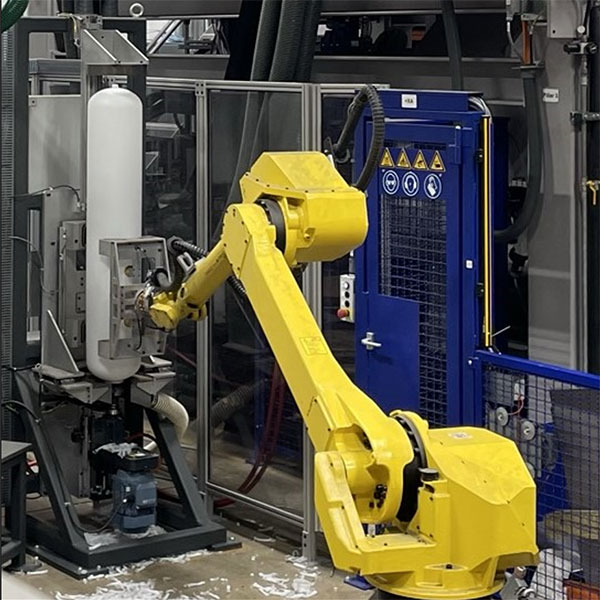
Robotic arms or conveyor systems reduce manual handling and improve throughput.
Mould Handling
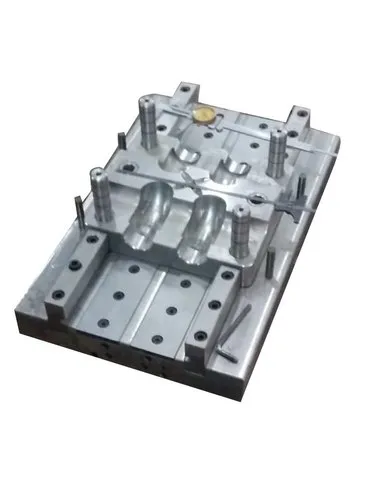
Servo-driven or hydraulic systems automatically open and close moulds.
Mould changeovers are faster with automatic tooling change systems, improving flexibility in production lines.
Blow Moulding Process Control
Advanced PLCs (Programmable Logic Controllers) and HMIs (Human-Machine Interfaces) manage temperature, air pressure, and timing with high precision.
PID control loops help maintain consistent processing conditions, minimizing scrap rates.
Quality Inspection and Vision Systems
Integrated vision systems inspect for defects like flash, incomplete blowing, or surface imperfections.
Non-contact sensors measure wall thickness, ensuring compliance with design specifications.
Post-Moulding Operations
Automation handles trimming, leak testing, and cooling.
Robotic systems can stack, pack, or convey finished products directly to downstream processes.
Maintenance and Predictive Monitoring
IoT-enabled systems provide predictive maintenance alerts, reducing downtime.
Machine learning models can analyze trends and recommend proactive maintenance schedules.
Types of Automation in Blow Moulding
Semi-Automated Systems: Require some operator input, often used in smaller-scale operations.
Fully Automated Systems: From preform loading to finished product packaging, everything is handled automatically.
Smart Manufacturing/Industry 4.0: Integration with MES (Manufacturing Execution Systems) and ERP (Enterprise Resource Planning) platforms enables data-driven decision-making.
Benefits and ROI
Higher Productivity: 24/7 operation with minimal supervision.
Improved Safety: Reduced human interaction with hot materials and moving parts.
Better Traceability: Automated tracking of batch numbers and production parameters.
Faster Time-to-Market: Streamlined processes reduce lead times.
Challenges
Initial Investment: High capital cost for setting up automated systems.
Technical Expertise: Skilled personnel are needed to operate and maintain advanced machinery.
System Integration: Compatibility with existing systems and processes can be complex.
Conclusion
Automation in blow moulding systems significantly enhances productivity, product quality, and operational efficiency. As the industry continues to move towards smart manufacturing, integrating automation technologies is not just a competitive advantage—it’s becoming a necessity.