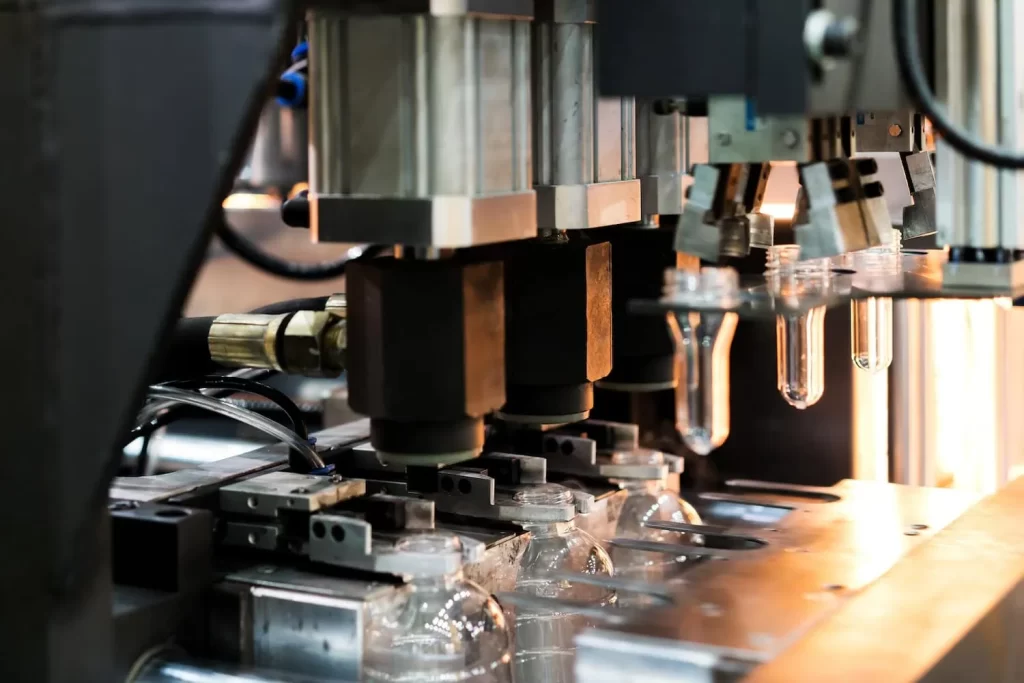
Blow moulding is a plastic manufacturing process used to create hollow plastic parts such as bottles, containers, and tanks. Proper control of heating and cooling systems is essential to ensure the quality, consistency, and efficiency of the blow moulding process.
1. Role of Heating in Blow Moulding
Heating is a critical step in blow moulding, as it softens the plastic to a pliable state so it can be formed into the desired shape. There are three main types of blow moulding processes: extrusion blow moulding, injection blow moulding, and stretch blow moulding. All these require precise temperature control for successful forming.
a. Heating Methods
Extrusion Blow Moulding: The plastic (usually in pellet form) is melted in a barrel using heaters and screw rotation. The molten plastic is then extruded into a parison (a tube-like form).
Injection Blow Moulding: The plastic is injected into a preform mould and heated to a specific temperature before being transferred to the blow mould.
Stretch Blow Moulding: A preform is heated, then stretched and blown into the final shape.
b. Heating Systems
Electric Heaters: Most commonly used in barrel zones and for preform conditioning.
Infrared (IR) Heaters: Used in stretch blow moulding to evenly heat preforms before blowing.
Hot Air Systems: Sometimes used for heating preforms or parisons to ensure even temperature distribution.
c. Importance of Heating Control
Prevents material degradation due to overheating.
Ensures uniform wall thickness and structural integrity.
Reduces cycle times by maintaining optimal temperatures.
2. Role of Cooling in Blow Moulding
Once the plastic has been shaped into the mould, it must be cooled to solidify and retain the final geometry. Efficient cooling reduces cycle time and ensures product consistency.
a. Cooling Methods
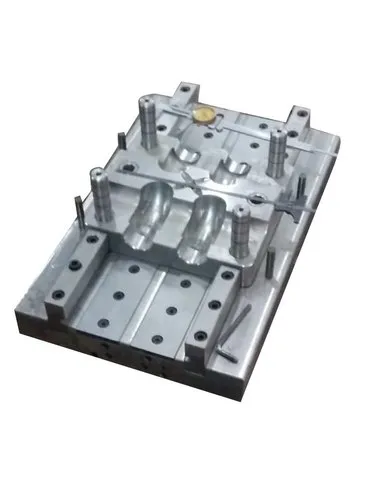
Mould Cooling: Water or oil channels in the mould circulate coolant to remove heat from the plastic part.
Air Cooling: In some cases, air jets or fans are used for initial or supplementary cooling.
Neck Cooling: In stretch blow moulding, specialized cooling is used for the neck area of the preform to avoid deformation.
b. Cooling Systems
Chilled Water Systems: Most commonly used; provide precise temperature control.
Thermal Fluid Systems: Used where higher mould temperatures are needed or for specialized polymers.
Cooling Towers or Closed-Loop Systems: Often part of plant-wide cooling infrastructure.
c. Importance of Cooling Control
Ensures dimensional stability and avoids warping or shrinkage.
Affects part clarity (important in transparent bottles).
Impacts cycle time and energy efficiency.
3. Integrated Temperature Control Systems
Modern blow moulding machines are equipped with automated temperature control systems that monitor and adjust heating and cooling parameters in real-time. These systems typically include:
Thermocouples and sensors
Programmable logic controllers (PLC)
Human-machine interfaces (HMI)
4. Common Challenges and Solutions
| Challenge | Solution |
|---|---|
| Uneven heating | Use infrared sensors and improve heater design |
| Overheating | Use segmented temperature zones |
| Inconsistent cooling | Optimize mould design and flow path |
| Long cooling time | Use high-efficiency chillers or cooling circuits |