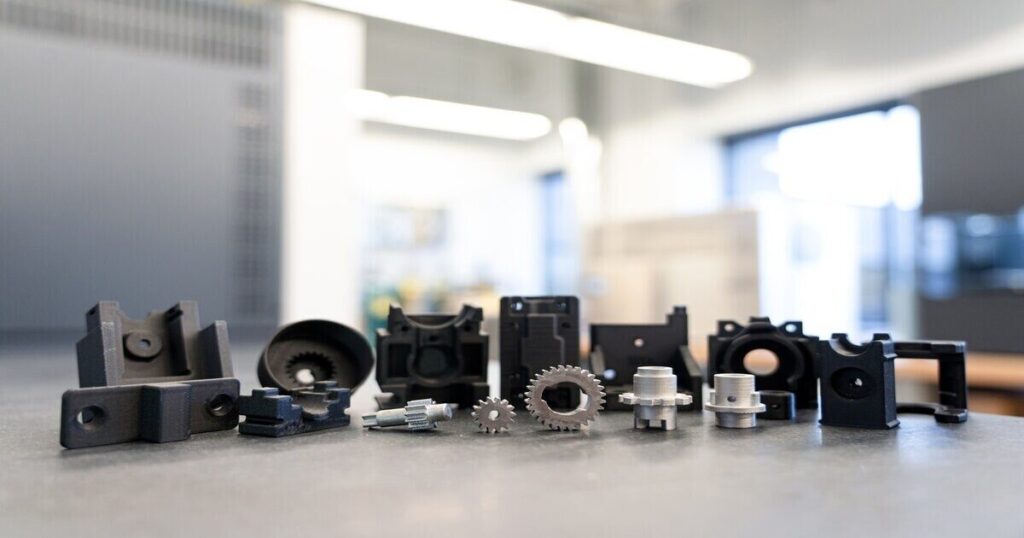
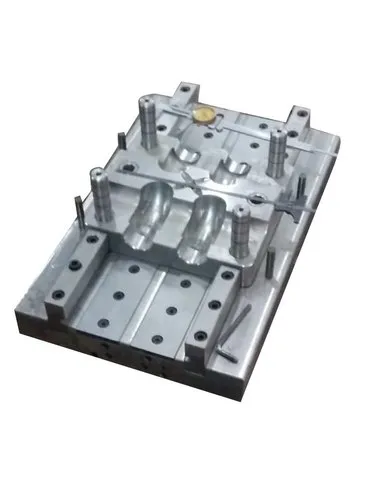
Additive Manufacturing (AM), commonly known as 3D printing, has significantly transformed the manufacturing landscape by enabling rapid prototyping, complex geometries, and cost-effective production. One of its most impactful applications is in the creation of prototype dies, which are essential tools used in forming operations such as stamping, forging, casting, and injection molding.
What is a Prototype Die?
A prototype die is a preliminary version of a die used to test and validate the design and function of parts before mass production. Traditional die-making is time-consuming and expensive, especially when changes are needed. 3D printing addresses these challenges by allowing faster and more flexible die development.
Role of Additive Manufacturing in Prototype Die Creation
Rapid Prototyping
3D printing drastically reduces the time required to produce prototype dies.
Designers can go from CAD models to physical prototypes in a matter of hours or days, rather than weeks.
Cost Efficiency
Traditional die-making involves expensive CNC machining and tooling.
3D printing minimizes material waste and labor costs, making it more economical for low-volume production and testing.
Design Flexibility
Additive manufacturing supports complex and optimized geometries that are difficult or impossible to achieve with subtractive methods.
Features such as conformal cooling channels and lattice structures can be integrated into the die design to improve performance.
Material Variety
While early 3D printing was limited to plastics, modern AM technologies support metals (e.g., stainless steel, tool steels, Inconel) suitable for functional prototype dies.
Hybrid approaches (3D printed base with machined surfaces) can balance speed and durability.
Iterative Testing and Optimization
Designers can rapidly modify and reprint dies based on testing results.
This supports a more agile product development cycle and helps achieve better product-die alignment before committing to final tooling.
AM Technologies Used in Die Prototyping
Fused Deposition Modeling (FDM)
Often used for basic form testing using thermoplastics.
Suitable for visual inspection and initial fitment checks.
Selective Laser Sintering (SLS) / Direct Metal Laser Sintering (DMLS)
Ideal for functional prototype dies with higher strength requirements.
Enables production of metal dies suitable for low-volume forming.
Stereolithography (SLA)
Provides high-resolution plastic parts.
Useful for detailed surface finish evaluation.
Binder Jetting and Metal Jet
Offers scalable metal part production.
Can be used to create complex shapes with post-processing like sintering.
Applications in Industry
Automotive: Prototype stamping dies for body panels and components.
Aerospace: Forming tools for lightweight composite parts and sheet metal.
Consumer Goods: Injection molds for product housings and packaging.
Medical Devices: Customized dies for short-run production and testing of implants or instruments.
Benefits of Using 3D Printing in Prototype Die Creation
| Benefit | Description |
|---|---|
| Faster Time-to-Market | Rapid production of dies accelerates the product development cycle. |
| Reduced Risk | Early testing of dies reduces the risk of costly errors in final tooling. |
| Customization | Easy to tailor dies for specific applications or small production batches. |
| Sustainability | Less material waste compared to subtractive manufacturing methods. |