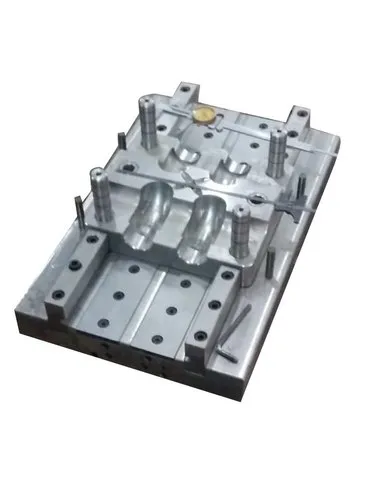
1. Definition
Compound Die:
A die that performs two or more cutting operations (such as blanking and piercing) in a single stroke at one station.Combination Die:
A die that performs both cutting and forming operations (such as bending, drawing, and cutting) simultaneously in a single stroke, typically at one station.
2. Type of Operations Performed
Compound Die:
Cutting operations only.
Examples: Blanking + Piercing.
Combination Die:
Cutting and forming operations.
Examples: Blanking + Bending or Piercing + Drawing.
3. Working Principle
Compound Die:
The punch is mounted on the upper half of the die set.
The die functions by punching through the material in a single stroke, achieving multiple cuts at once.
Combination Die:
Incorporates both cutting and forming punches/dies in one setup.
Material is simultaneously cut and formed as the press closes.
4. Applications
Compound Die:
Suitable for high-precision, high-volume cutting operations.
Often used in washer production, electronic parts, etc.
Combination Die:
Used when components require both forming and cutting.
Ideal for manufacturing parts like connectors, housings, or shaped metal pieces.
5. Advantages
Compound Die:
Faster production rate due to multiple cutting actions in one stroke.
High dimensional accuracy.
Combination Die:
Reduces the number of setups or stations needed.
Efficient for parts requiring both forming and cutting.
6. Limitations
Compound Die:
Not suitable for forming operations.
Tooling wear can be significant due to multiple cutting actions.
Combination Die:
More complex and expensive to design and maintain.
Setup requires higher precision to align forming and cutting tools.