1. Introduction to Blow Moulding
Blow moulding is a manufacturing process used to produce hollow plastic components such as bottles, containers, and tanks. It involves inflating a heated plastic tube (called a parison) inside a mould cavity so that it conforms to the shape of the mould. Once cooled, the mould opens and the formed part is ejected.
There are three main types of blow moulding:
Extrusion Blow Moulding (EBM)
Injection Blow Moulding (IBM)
Stretch Blow Moulding (SBM)
2. Role of Dies in Blow Moulding
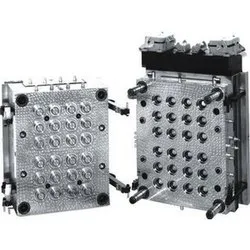
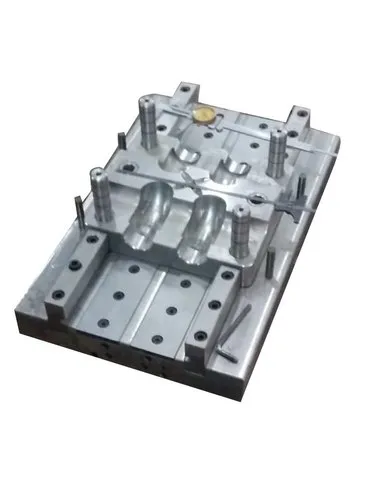
The die in a blow moulding machine is a critical component responsible for shaping the parison or preform before it is inflated inside the mould. The quality, consistency, and properties of the final product depend heavily on the design and function of the die.
3. Components of a Blow Moulding Die
A blow moulding die generally consists of the following components:
Die Head: The part where molten plastic is distributed and shaped into a parison.
Mandrel/Pin: Helps control wall thickness and inner diameter of the parison.
Die Lips: Control the shape and uniformity of the extruded parison.
Flow Channels: Direct molten plastic uniformly around the die.
4. Die Design Considerations
Proper design of blow moulding dies is essential for:
Uniform wall thickness
Elimination of flow marks and weak spots
Consistent part dimensions
Material efficiency
Key factors include:
Parison Programming: Adjusting wall thickness by controlling die gap during extrusion.
Die Gap Control: Either fixed or variable, to control parison diameter and wall thickness.
Material Flow Characteristics: Viscosity and temperature must be considered to prevent flow imbalance.
Symmetry: Ensures even inflation and uniform part quality.
5. Types of Blow Moulding Dies
Blow moulding dies vary depending on the process:
a. Extrusion Blow Moulding Dies
Used in continuous or intermittent extrusion.
Common die types: Center-fed, Side-fed, and Accumulator head.
Designed to handle larger volumes and thicker parts (e.g., fuel tanks).
b. Injection Blow Moulding Dies
Preform is injection moulded and then blown.
Dies are highly precise and require tight tolerances.
Used for small, high-precision containers (e.g., pharmaceutical bottles).
c. Stretch Blow Moulding Dies
Preform is stretched and blown to form the final product.
Die is part of the injection stage; blow mould is separate.
Common in PET bottle manufacturing.
6. Materials Used for Dies
Blow moulding dies must withstand high pressure, temperature, and abrasion. Common materials include:
Tool steels (e.g., H13, P20)
Aluminum alloys (for lightweight, lower-volume production)
Beryllium copper (excellent thermal conductivity)
Surface treatments like chrome plating or nitriding are often used to extend die life.
7. Maintenance of Blow Moulding Dies
Regular maintenance is essential to ensure optimal performance:
Cleaning to remove polymer buildup
Inspection for wear or damage
Lubrication of moving parts
Calibration of die gap systems
8. Common Issues and Troubleshooting
Non-uniform wall thickness: Often due to improper die gap or poor parison control.
Flash formation: Excess material at the mould parting line—caused by high parison pressure or misaligned dies.
Flow marks or weld lines: May occur due to imbalanced flow or inadequate die design.
9. Recent Innovations in Die Technology
Computer-aided die design (CADD) and CFD simulation for optimal flow paths.
Programmable parison control systems for dynamic wall thickness adjustments.
Quick-change dies for faster production changeovers.
Modular die systems for multi-layer or multi-material blow moulding.
10. Applications of Blow Moulding Dies
Blow moulding dies are used in producing:
Plastic bottles (water, soda, juice)
Fuel tanks
Industrial drums and containers
Automotive ducts
Household and cosmetic packaging
Conclusion
Blow moulding dies are the heart of the blow moulding process, dictating the quality, strength, and efficiency of hollow plastic parts. As materials and product designs become more complex, the demand for high-performance, precision-engineered dies continues to grow. Understanding die design, operation, and maintenance is crucial for any successful blow moulding operation.