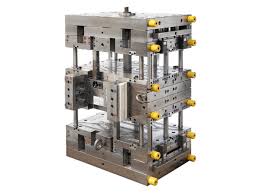
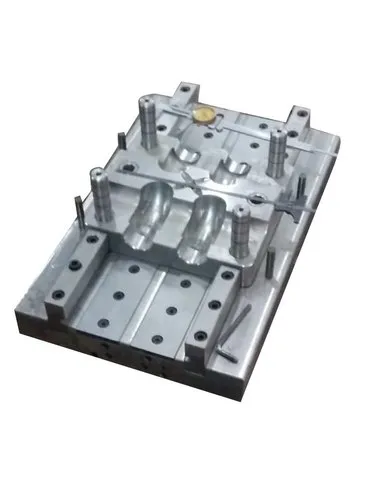
Stack moulds are advanced moulding tools used in the injection moulding industry to increase productivity and efficiency. In the production of houseware items—such as containers, kitchen tools, storage boxes, and other household plastic products—stack moulds offer significant advantages in terms of output and cost-effectiveness.
What are Stack Moulds?
Stack moulds consist of two or more levels (or “stacks”) of parting lines arranged within a single mould base. Each level can produce parts simultaneously during one injection cycle. Unlike conventional moulds that have a single parting line, stack moulds make better use of the machine’s clamping force and shot capacity, allowing multiple parts to be moulded at once.
Key Features of Stack Moulds
Multi-level Design: Usually 2 or 3 plates (e.g., 2-level or 3-level stack moulds)
Single Injection System: One injection unit feeds all cavities in different levels.
Balanced Filling: Ensures all cavities are filled simultaneously and uniformly.
Efficient Cooling: Designed with optimized cooling channels for rapid cycle times.
Compact Footprint: More output without needing larger machines or additional floor space.
Advantages in Houseware Production
Increased Productivity
Allows simultaneous production of multiple parts in a single cycle.
Doubles or triples output without increasing cycle time significantly.
Cost Efficiency
Reduces cost per part by maximizing the machine’s output.
Lower labour and operational costs due to fewer cycles for the same quantity.
Better Use of Machine Capacity
Optimizes clamping force and shot size of high-tonnage injection moulding machines.
Space Savings
Produces more without needing multiple machines or larger moulds.
Consistency and Quality
Ensures consistent part dimensions across multiple cavities.
Applications in Houseware Products
Stack moulds are ideal for high-volume production of:
Plastic storage containers and lids
Food storage boxes
Kitchenware items like bowls, measuring cups, or colanders
Plastic trays and organizers
Bathroom accessories
Buckets and pails (for lightweight versions)
Challenges and Considerations
While stack moulds offer many benefits, there are some technical and operational challenges:
Higher Initial Investment: Tooling and design costs are higher than standard moulds.
Complex Maintenance: More components mean more complex maintenance routines.
Machine Compatibility: Requires injection machines with sufficient clamping force and shot capacity.
Cooling Efficiency: Needs carefully designed cooling systems to avoid longer cycle times.
Conclusion
Stack moulds represent a smart investment in houseware production, especially for manufacturers focused on high-volume, high-efficiency output. By enabling the production of multiple parts per cycle without increasing machine size or footprint, they provide a competitive edge in both productivity and cost savings. With proper design, operation, and maintenance, stack moulds can significantly enhance the profitability and scalability of houseware manufacturing operations.